
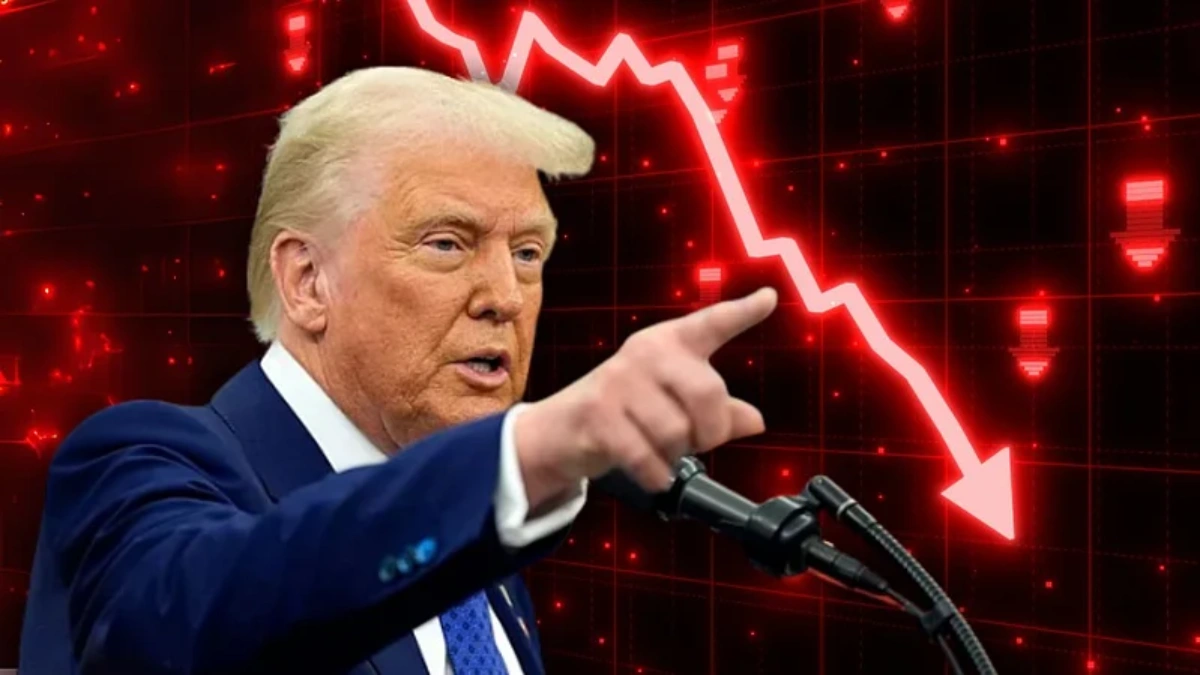
The question of whether the U.S. stock market is headed for another historic crash has resurfaced once again — this time under the leadership of President Donald Trump in his second, non-consecutive term. With memories of the COVID-19 market collapse still fresh and recent bouts of volatility rattling investors, speculation is growing louder: Is a third major stock market crash imminent?
To answer this responsibly, it’s important to move beyond headlines and fear-driven commentary and examine what the actual data, historical patterns, and economic indicators reveal. The reality, as with most market questions, is far more nuanced than a simple yes or no.
Understanding “Historic” Market Crashes

Before assessing current risks, it’s worth defining what constitutes a historic stock market crash. In financial terms, a crash is typically understood as a rapid and steep decline of 30% or more in major market indices over a short period.
Under Donald Trump’s political era, two major downturns are frequently cited:
- The COVID-19 Crash (2020):
Triggered by a global pandemic, the S&P 500 plunged roughly 34% in just over a month — one of the fastest collapses in history. - Policy-Driven Sell-Offs:
Short-term but sharp declines linked to trade tensions, tariffs, and geopolitical uncertainty during Trump’s first presidency and early second term.
While both events were severe, they stemmed from extraordinary external shocks, not structural weaknesses alone. This distinction matters when evaluating the likelihood of another crash.
Market Performance Under Trump’s Second Term So Far
Since Donald Trump returned to office in January 2025, U.S. equity markets have shown overall upward momentum, despite intermittent volatility.
- The S&P 500 has recorded solid gains.
- The Nasdaq Composite continues to outperform, driven largely by technology and AI-related stocks.
- The Dow Jones Industrial Average has also trended higher, supported by industrial and financial sectors.
Although markets have experienced sharp pullbacks following policy announcements or geopolitical developments, these declines have so far resembled corrections, not crashes.
This suggests that while uncertainty exists, investor confidence has not collapsed, a key ingredient typically present before major market crashes.
Valuations: A Legitimate Concern, Not a Timer
One of the strongest arguments fueling crash fears is elevated market valuations.
The Shiller Price-to-Earnings (CAPE) ratio, a long-term valuation metric adjusted for inflation, currently sits well above its historical average. In fact, it is near levels previously seen before the dot-com bubble burst in the early 2000s.
High valuations imply:
- Future returns may be lower
- Markets are more vulnerable to bad news
- Risk premiums are compressed
However, valuation metrics are not crash timers. Markets can remain overvalued for years, as seen in the late 1990s or during the post-pandemic rally. High valuations increase risk — they do not guarantee imminent collapse.
The Role of Trump’s Economic Policies

President Trump’s economic agenda has historically focused on:
- Tariffs and trade renegotiation
- Corporate tax incentives
- Deregulation
- “America First” manufacturing policies
These policies have had mixed effects on markets.
On one hand:
- Corporate profits have benefited from lower taxes and deregulation.
- Domestic manufacturing and energy stocks have seen periodic boosts.
On the other:
- Tariffs increase costs for companies reliant on global supply chains.
- Trade tensions create uncertainty, which markets dislike.
Importantly, markets have already demonstrated an ability to absorb Trump-related policy shocks, often rebounding after initial sell-offs. This adaptability reduces the likelihood of sudden systemic collapse purely from policy decisions.
Volatility Does Not Equal a Crash

Recent market movements have been volatile, leading many investors to confuse volatility with collapse.
Volatility reflects uncertainty, not failure. In fact:
- Elevated volatility often occurs during late-cycle bull markets.
- Markets frequently experience 5–10% pullbacks even during strong long-term uptrends.
- Corrections of 10–20% are historically normal and healthy.
True crashes usually involve:
- Liquidity breakdowns
- Widespread panic selling
- Banking or credit system stress
- Massive earnings deterioration
At present, none of these conditions appear simultaneously in the U.S. economy.
Economic Indicators: Mixed but Not Alarming

A broader look at macroeconomic data provides important context.
Positive Signals
- Corporate earnings remain resilient.
- GDP growth, while uneven, has not collapsed.
- Employment levels remain historically strong.
- Banks are better capitalized than before the 2008 crisis.
Cautionary Signals
- Consumer confidence has weakened.
- Inflation concerns persist.
- Interest rates remain restrictive.
- Household debt levels are rising.
This mixed picture suggests economic cooling, not economic freefall. Historically, crashes tend to follow sharp economic contractions — not gradual slowdowns.
Geopolitical and Global Risks

Markets today face undeniable global risks:
- Middle East tensions
- Trade disputes
- Election-related uncertainty
- Slowing global growth
However, geopolitical risk alone rarely causes sustained market crashes unless it directly impacts:
- Energy supply
- Financial systems
- Global trade flows
So far, global disruptions have increased volatility but have not triggered systemic breakdowns in financial markets.
What History Really Teaches Us

Looking at more than a century of market history reveals a key truth:
Crashes are rare, unpredictable, and usually triggered by extreme events.
Examples include:
- The Great Depression (banking collapse)
- The 2008 financial crisis (housing and credit failure)
- The 2020 pandemic (global economic shutdown)
Trump’s presidency — past and present — has produced volatility, but not the kind of structural imbalances typically associated with crashes.
So, Is a Third Historic Crash Imminent?
Based on available data, the answer is no clear evidence suggests an imminent historic stock market crash.
What is likely:
- Continued volatility
- Periodic corrections
- Sector-specific bubbles deflating
What is not currently evident:
- A collapsing financial system
- Mass corporate insolvency
- Liquidity crisis
- Uncontrolled panic selling
Crashes don’t usually announce themselves — but they also don’t emerge without deep underlying stress.
What Investors Should Focus On Instead

Rather than attempting to predict crashes, history shows investors are better served by:
- Diversification across assets and sectors
- Long-term discipline, not emotional trading
- Risk management, not market timing
- Data-driven decisions, not political narratives
Markets reward patience far more often than panic.
Conclusion
Fear sells headlines, but data tells a calmer story.
While Donald Trump’s presidency brings policy uncertainty and market swings, the evidence does not currently support claims of an imminent third historic stock market crash. Elevated valuations and geopolitical risks warrant caution — not alarm.
As always, markets will rise, fall, and fluctuate. But history suggests that staying invested, informed, and disciplined remains the most reliable strategy — regardless of who occupies the White House.