
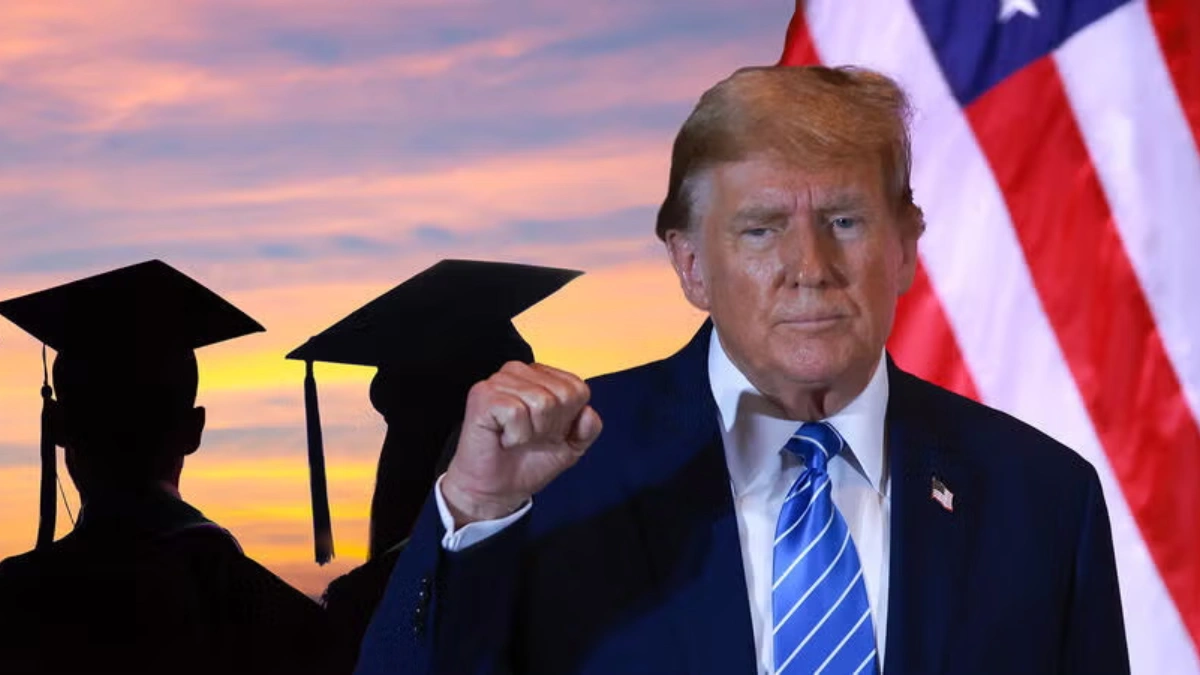
Universities higher education in United States have long been hubs for political discussion, invention, and intellectual advancement. They have fuelled social movements, influenced politics, and fuelled research that drives industry. These same organisations, however, are the target of an unprecedented government crackdown during President Donald Trump’s second term. Funding has been weaponised as the main means of control in what started out as verbal attacks on “woke culture” and has since grown into a broad campaign to discipline higher education.
The administration’s approach reflects a fundamental reworking of the relationship between colleges and the federal government, going beyond simply suppressing ideological opponents. Once an investment in the advancement of the country, research funds are today utilised as leverage to compel conformity.
Trump Administration Eyes Intel Nationalization in New ‘Manhattan Project’ for Chips
The Strategy: Power Through Purse Strings

Trump’s strategy for higher education centres on three issues: Diversity, Equity, and Inclusion (DEI) initiatives, pro-Palestinian demonstrations, and antisemitism. However, underneath the rhetoric comes a political reality: institutional autonomy, student visas, and federal research subsidies are now negotiating chips.
- Compliance demanded: Universities are warned that they risk losing millions of dollars if they don’t change admissions, reorganise programs, or enforce protest regulations.
- Punishment for dissent: Settlements are being requested on an unprecedented scale, lawsuits are being threatened, and grants are being halted.
- Visibility of control: Institutions that used to have autonomy are now expected to show allegiance to federal orders.
In actuality, financial pressure rather than intellectual discussion is reshaping academia.
Sam Altman on OpenAI’s Future: Why He May Not Be the Right CEO if OpenAI Goes Public
Early Settlements: Columbia and Brown Set the Tone

Columbia University: A $200 Million Price Tag
Columbia was one of the first significant universities to come under strain, frequently being the target of student demonstrations. After funding for research was cut off, the university consented to a $200 million settlement. Concessions included:
- Overhauling admissions and disciplinary procedures.
- Imposing stricter protest regulations.
- Restructuring Middle East–related academic programs.
Critics contend that although Columbia was able to access government cash again, the agreement diminished its autonomy.
Brown University: Workforce Concessions
Brown University agreed to a modest but symbolic agreement: $50 million, which was contingent on additional pledges to workforce development programs and changes to existing policies. This arrangement demonstrated how susceptible even prestigious private organisations were to federal influence.
These agreements collectively had a chilling impact on higher education, demonstrating that cooperation meant scrutiny and expensive concessions, while resistance may entail financial ruin.
Bitcoin Smashes Records, Hits $124,500 Amid Policy Support and Institutional Buying
The Big Battles: UCLA and Harvard

UCLA: A Billion-Dollar Demand
UCLA has been accused of neglecting to protect Jewish students during campus protests in the public sector. According to reports, the administration sought an astounding $1 billion settlement and froze $584 million in grants. Critics say that the demand could ruin the university’s financial stability and label it punitive and unprecedented.
Harvard: Billions on the Line
Harvard may seem protected by its endowment of more than $50 billion. However, more than $2.3 billion in government grants have been suspended. A $500 million settlement linked to modifications in college policy, namely with regard to DEI programs, has been advocated by the administration. Although Harvard has fought harder than other universities—even going so far as to file legal challenges—the extended moratorium jeopardises the university’s position as a leader in international research.
Record US Tariff Collections in July 2025 — Celebration and Concern
The $3.7 Billion Purge: Nationwide Cuts

In addition to settlements, the Trump administration has suggested targeted reductions of $3.7 billion in federal research funding for colleges around the country. This move’s scope has the potential to upend entire academic disciplines.
Johns Hopkins: The Largest Target
- Proposed cut: $245 million.
- Why targeted: Defence and public health contracts are closely linked to Johns Hopkins, which is the largest beneficiary of federal research funds in the United States. Its targeting is indicative of the U.S. biomedical leadership because of its importance in pandemic response.
Harvard: A Cultural and Legal Rival
- Proposed cut: $127 million, separate from frozen grants.
- Why targeted: Harvard has frequently opposed the administration in legal and cultural disputes.
Other Major Targets
- Arizona State University (ASU): $125 million, demonstrating its leadership in immigration, AI, and clean technology.
- Texas A&M and Columbia: $100 million each.
- UNC and Tufts: Around $90 million each, reflecting their visibility in protests and debates over race.
- UC Berkeley, South Dakota State, Clemson: Between $81–$87 million each, showing the crackdown is geographically broad and politically diverse.
Compliance at a Cost: U.S. Universities Priced Into Silence

The fundamental reasoning behind the campaign is straightforward: compliance is safer and disagreement is more expensive.
- Settlements as leverage: Millions were spent by Brown and Columbia to reinstate grants. The demand at UCLA is billions of dollars. Harvard is battling for $2.3 billion.
- Policy shifts under pressure: DEI offices are either reorganised or demolished. Protest laws are revised to conform to federal requirements.
- Silence as survival: These days, universities balance the financial cost of resistance against the cost of speaking out against policies.
Dissenters were publicly named and humiliated during the raucous McCarthy era, but this is not the case here. It is a more subdued and effective approach, where higher education are compelled to comply through economic pressure rather than being dragged into hearings.
Trump’s Tariff Offensive: Global Trade Politics Take an Unexpected Turn
Broader Implications for Academia and Society

Threat to Scientific Leadership
Targeting research-heavy universities like Harvard and Johns Hopkins runs the risk of eroding American leadership in clean technology, defence innovation, and biomedical science. Funding cuts of billions could put a stop to initiatives that are essential to being competitive globally.
Erosion of Institutional Autonomy
Universities have historically struck a compromise between internal governance and public accountability. Federal mandates are now undermining the authority of faculty senates and boards.
Academic Freedom at Risk
Political agendas are increasingly influencing the rewriting of policies that were originally developed by academics and educators. Financial retaliation may result from student demonstrations and contentious research topics.
Long-Term Precedent
Federal funding can be utilised as both control and support, as the campaign sets a potent precedent. Academic freedom may become dependent on political affiliation if future administrations, regardless of their ideology, pursue similar strategies.
OpenAI Launches GPT-5: India Positioned as Key Market in Global AI Push
Conclusion
Higher education in America has reached unprecedented heights during Trump’s second term. Universities are now viewed as tools to be reformed and disciplined through financial pressure rather than as collaborators in the advancement of the country.
The stakes are high. Public health research in the United States will suffer if Johns Hopkins loses its biomedical funding. Harvard’s academic independence will be severely damaged if it accedes to federal demands. Access to reasonably priced education is weakened if public colleges like UCLA are burdened with billion-dollar fines.
A new order takes shape, with silence becoming the safest course of action, compliance bringing survival, and opposition carrying a price. Funding for research has evolved from being solely focused on discovery to becoming a political enforcement weapon.
There is more to this change than just a policy disagreement for a country that has always taken pride in the autonomy and calibre of its colleges. It is a slight but significant deterioration of one of the intellectual pillars of the republic. It might also change American higher education for future generations if it is not opposed.