
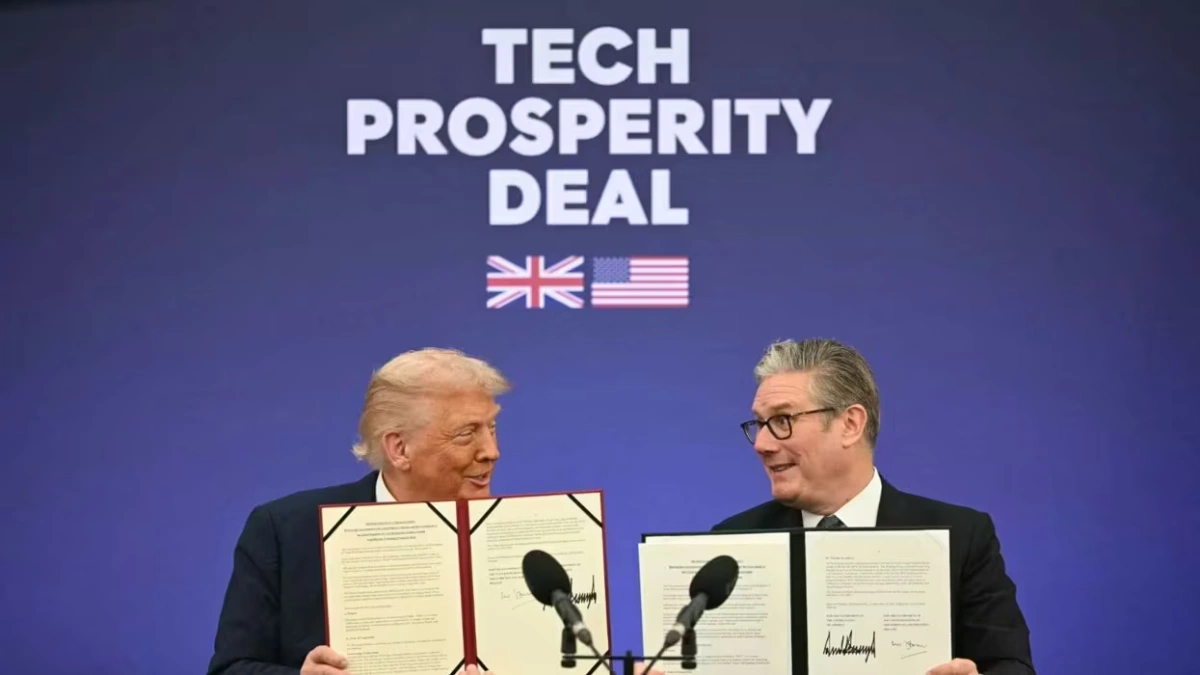
According to reports, the United States has halted the implementation of the widely touted “Tech Prosperity Deal” with the United Kingdom. This action has cast doubt on what was supposed to be the cornerstone of future-focused collaboration between two longstanding allies. The deal, which was made public in September during President Donald Trump’s visit to Britain, was intended to strengthen cooperation in vital and developing technologies, such as nuclear energy, quantum computing, and artificial intelligence (AI). The suspension highlights the increasingly intricate relationship between trade negotiations, technology policy, and geopolitical leverage. It was confirmed by British officials in the middle of December.
US Government Launches Tech Force to Recruit 1,000 Engineers for Federal Service
Background: Origins and Objectives of the Tech Prosperity Deal

The Tech Prosperity Deal was designed as a strategic framework to bring the US and the UK together in areas that are anticipated to influence national security and economic competitiveness in the next decades. Fundamentally, the agreement aimed to promote collaborative research, unify regulatory strategies when feasible, and enable international investment in cutting-edge technologies. The deal sought to put both nations at the forefront of innovation while lowering vulnerabilities in global supply chains by concentrating on AI, quantum computing, and nuclear energy.
The agreement was also a sign of the UK’s desire to establish itself as a post-Brexit global centre for technology. In a period when technology leadership has emerged as a key component of strategic competition, it offered the US a chance to strengthen ties with reliable allies.
Trump Unveils the Gold Card Visa Program: A High-Priced Fast Track for Retaining Global Talent
Confirmation of the Suspension

The Financial Times reported that British authorities acknowledged on Monday, December 15, that the agreement had been suspended by the Trump administration the week before. According to a UK official quoted in the report, the hiatus was being used as leverage in larger trade negotiations rather than being caused by differences over the technology agenda itself. This disclosure raises the possibility that the technological collaboration is now involved in unresolved trade disputes that go far beyond its initial purview.
The agreement’s implementation is put on hold by the suspension, which raises concerns about deadlines, political commitment, and the sustainability of bilateral collaboration in delicate technology areas.
Google Launches “Deep Think” in Gemini 3: A Mode Built for Deliberate Reasoning
Trade Negotiations as the Underlying Context

Since May, the United States and the United Kingdom have been engaged in trade negotiations with the goal of resolving a number of long-standing disputes. According to reports, these talks have been difficult since both parties want to make concessions on issues with domestic political and economic ramifications. In this regard, the Tech Prosperity Deal seems to have evolved from a stand-alone project free from trade pressures to a negotiating tool.
According to a British official quoted in publications, the negotiations have reached a particularly challenging stage. Despite characterising their US colleagues as “very tough negotiators,” the official expressed optimism that the negotiations may resume, suggesting that neither side saw the current deadlock as irreparable.
Bitcoin Surges Past 92,000 Dollars as Markets Await High-Stakes Federal Reserve Decision
Points of Friction: Online Safety, Digital Taxes, and Food Standards

The US has reportedly become frustrated during the trade negotiations due to a number of policy concerns. These include food safety regulations, Britain’s digital services tax (DST), and its internet safety regulations. Each of these topics touches on conflicting regulatory ideologies and delicate domestic objectives.
The UK’s online safety framework, which aims to hold digital platforms more accountable for harmful content, has caused US tech businesses to worry about the expense of compliance and the scope of regulations. Similar to this, food safety regulations have historically been controversial in talks about transatlantic commerce and frequently reflect deeply ingrained popular perceptions.
Global Markets on Edge: Fed Decision, Central Bank Wave, and China Data Set the Tone for 2026
The Digital Services Tax Debate

One of the most contentious aspects of the larger negotiations is the tax on internet services. Large digital platforms, many of which have their headquarters in the US, are the target of the tax. In the past, President Trump has denounced these levies levied by trading partners, claiming that they unfairly target American technological companies.
A UK official briefed on the negotiations, however, minimised the DST’s significance in the Tech Prosperity Deal’s delay. The official claims that the tax has turned into a “red herring,” drawing attention away from the more intricate and delicate political problems that are still being negotiated. Given the challenge of balancing conflicting policy agendas, the official stressed that both parties are still in communication and anticipate a lengthy process.
Blue Origin Launches NASA’s Escapade Mission to Mars: A New Chapter in Commercial Space Exploration
Diplomatic Messaging and Official Responses

UK officials have been cautious to convey confidence in the wider partnership despite the alleged suspension. The so-called “special relationship” between the United States and the United Kingdom is still robust, according to a government spokesperson. Additionally, the representative reiterated the UK’s commitment to making sure that the Tech Prosperity Deal eventually produces real advantages for firms and workers in both nations.
This restrained response reflects an attempt to reassure domestic and foreign audiences that the cooperation has not been fundamentally disrupted and to manage the political damage from the suspension.
Perplexity’s Comet AI Browser Expands to Android: Redefining the Future of Mobile Browsing
Strategic Importance of Technology Cooperation

The Tech Prosperity Deal’s halt is noteworthy due to the strategic significance of the technologies it covers. Many people believe that quantum computing and artificial intelligence are revolutionary fields that will have a significant impact on societal organisation, economic growth, and security capabilities. Conversely, conversations on energy security and the shift to low-carbon power continue to revolve around nuclear energy.
At a time when international rivalry is escalating, both nations run the danger of reducing growth by postponing collaboration in key areas. As a result, the suspension has effects that go beyond bilateral ties and may have an impact on the larger technological landscape.
US Stock Futures Rise on Hopes of Ending the Longest US Government Shutdown
Domestic Political Considerations
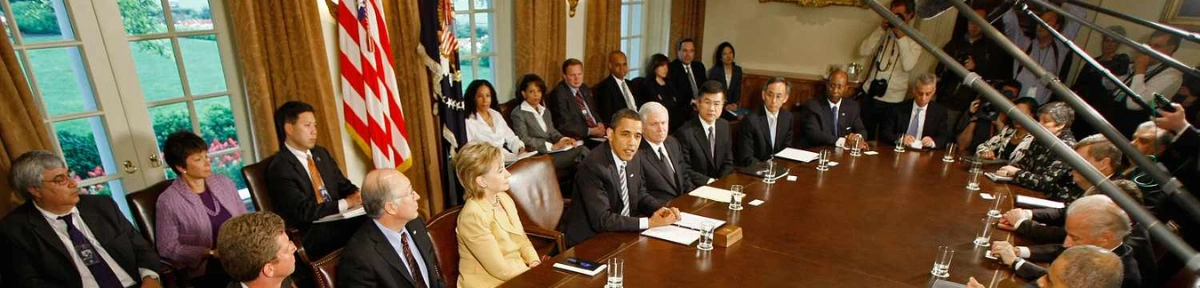
The negotiations are also shaped by domestic politics on both sides of the Atlantic. Trade policy and technology company regulation are politically sensitive topics in the US, especially when it comes to safeguarding jobs and homegrown businesses. In the UK, public trust and post-Brexit sovereignty are intimately associated with regulatory frameworks including food standards and online safety regulations.
For policymakers, sustaining a positive bilateral relationship while juggling these domestic concerns is a difficult task.
Microsoft’s Next-Generation Xbox: A Revolutionary Fusion of Console and PC Gaming
Prospects for Resolution

The Tech Prosperity Deal’s suspension is a setback, but it does not necessarily indicate a long-term breakdown. Both nations’ officials have stated that talks are still ongoing and that both nations are interested in coming to a consensus. The suspension could be lifted if controversial trade concerns are resolved, according to the use of the suspension as leverage.
Whether the agreement can be restored and carried out as originally planned or if it will need to be modified to take into account new political and economic realities will probably be determined in the upcoming months.
OpenAI’s Upcoming AI Music Generator: Redefining the Sound of Creativity
Conclusion: A Test of the Special Relationship
The US-UK Tech Prosperity Deal‘s alleged suspension serves as a reminder of how difficult it is to strike a balance between collaboration and rivalry in contemporary international relations. Although both countries acknowledge the advantages of working together on cutting-edge technologies, unresolved trade issues and regulatory obstacles have made progress more difficult.
Washington and London’s capacity to distinguish between short-term negotiation strategies and long-term strategic goals will be tested by how they handle this standoff. The Tech Prosperity Deal might still become a defining characteristic of transatlantic technology cooperation if it is successfully addressed. If not, its suspension might serve as a warning that even the most promising alliances might be damaged by wider trade conflicts.