
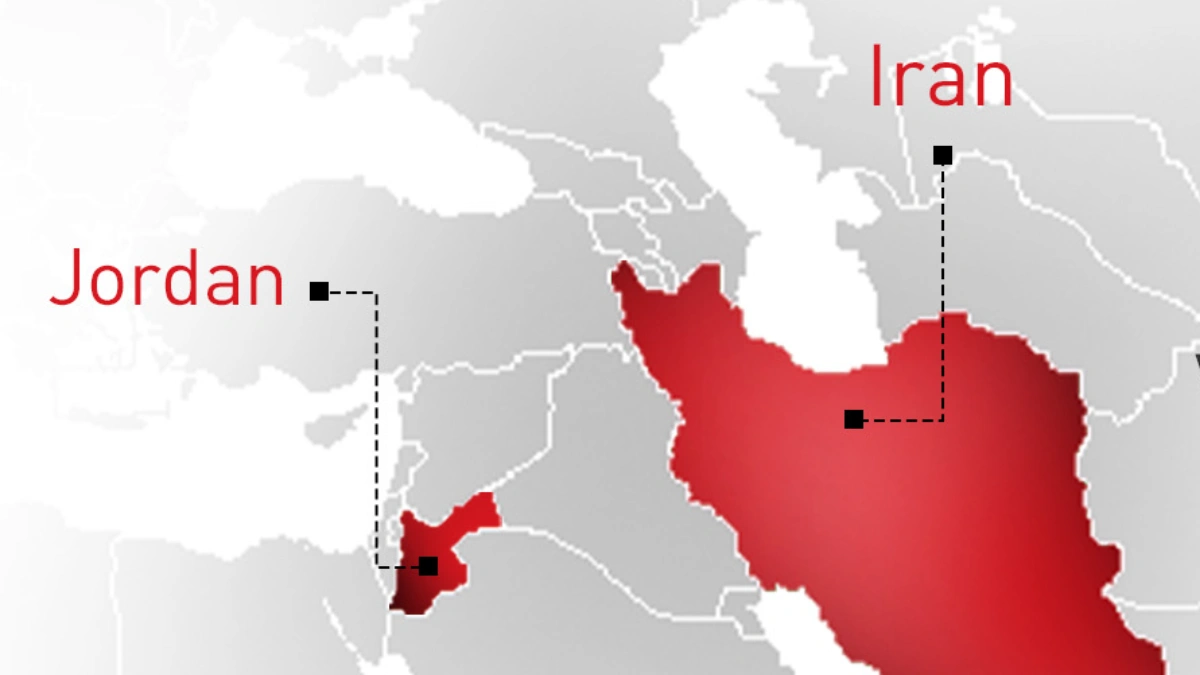
The recent escalation in the Middle East has raised a critical question: Why is Iran increasingly targeting Jordan? At first glance, Jordan appears to be a country that has generally avoided direct military confrontation with Iran. However, recent developments suggest that Jordan has become a strategic battleground in the broader conflict involving Iran, the United States, and Israel.
Rather than being an isolated conflict between Iran and Jordan, the attacks reflect Iran’s broader military and geopolitical strategy aimed at weakening U.S. and allied military operations across the region.
Jordan’s Strategic Importance
Jordan occupies one of the most strategically valuable locations in the Middle East. It borders:
- Israel
- Syria
- Iraq
- Saudi Arabia
Its location makes it a critical military and intelligence hub for Western allies.
For decades, Jordan has maintained close security cooperation with the United States and has signed peace agreements with Israel. It hosts military facilities used by U.S. forces, participates in intelligence sharing, and plays an important role in regional stability.
Because of these relationships, Iran increasingly views Jordan as part of the broader military network supporting U.S. and Israeli operations.
Iran Is Not Fighting Jordan Alone

It is important to understand that Iran’s recent attacks are primarily directed at U.S. military assets and allied infrastructure located in Jordan, rather than an attempt to conquer or wage a traditional war against the Jordanian state.
Recent Iranian missile and drone strikes have targeted military installations used by American forces, including air bases in Jordan that support U.S. regional operations. These attacks followed intensified U.S. strikes against Iranian military infrastructure.
Why Jordan Has Become a Target

1. Presence of U.S. Military Bases
Jordan hosts several military facilities used by American forces.
Iran believes these bases help:
- Launch surveillance missions
- Support logistics
- Coordinate regional military operations
- Protect Israeli airspace
By striking these locations, Iran seeks to increase the costs for the United States without directly attacking the U.S. mainland.
2. Jordan’s Cooperation with Israel
Jordan maintains diplomatic relations with Israel and has, at times, intercepted missiles and drones passing through its airspace.
Iran views this as active assistance to Israel’s defense.
Some reports indicate that Jordanian air-defense systems have intercepted Iranian projectiles, reinforcing Tehran’s perception that Jordan is contributing to the protection of Israeli territory
3. Regional Deterrence
Iran’s broader strategy appears designed to send a warning to countries that support U.S. military operations.
The message is that states hosting American forces could also become targets if conflict escalates.
Analysts describe this as an effort to expand the costs of military pressure on Iran beyond its immediate adversaries.
4. Expanding the Battlefield
Instead of concentrating solely on Israel, Iran has broadened its focus to include U.S. positions and allied infrastructure in several countries, including Jordan, Kuwait, and Bahrain.
This wider approach forces the United States to defend multiple fronts simultaneously and complicates military planning.
Why Doesn’t Iran Attack Israel Alone?
Several strategic reasons explain this.
Strong Israeli Defenses
Israel possesses one of the world’s most advanced air-defense systems, including:
- Iron Dome
- David’s Sling
- Arrow missile defense
These systems intercept many incoming missiles.
U.S. Support
Israel receives extensive military support from the United States.
Any direct confrontation with Israel carries the risk of broader U.S. involvement.
Jordan’s Position
Jordan has consistently stated that it does not seek conflict with Iran.
Its priorities remain:
- Protecting national sovereignty
- Securing its borders
- Preventing missile debris from harming civilians
- Preserving regional stability
However, Jordan’s strategic partnerships with the United States and its peace treaty with Israel make it difficult to remain entirely outside the conflict
Risks for Jordan

The growing confrontation creates several challenges.
Security Threats
Repeated missile and drone attacks increase the risk of civilian casualties and damage to infrastructure.
Economic Pressure
Heightened instability may discourage tourism and foreign investment, both important sectors of Jordan’s economy.
Diplomatic Pressure
Jordan must balance relationships with:
- The United States
- Israel
- Gulf Arab countries
- Regional neighbors
while avoiding deeper involvement in the conflict.
Could the Conflict Spread Further?
Many analysts warn that continued attacks could draw additional countries into the crisis.
Possible consequences include:
- More strikes on U.S. bases in the region
- Increased attacks on military infrastructure
- Disruptions to shipping routes
- Higher global oil prices
- Greater regional instability
Recent exchanges between Iran and the United States suggest that the conflict has already widened beyond its initial scope.
International Response
The United States has responded with additional strikes against Iranian military facilities following attacks on its personnel in Jordan. Meanwhile, Gulf states and European governments have called for restraint and urged all parties to avoid further escalation.
Conclusion
Iran’s recent attacks involving Jordan are less about seeking war with the Kingdom itself and more about targeting what Tehran sees as a key part of the U.S.-led regional security network. Jordan’s geographic location, its close cooperation with Washington, and its peace agreement with Israel have made it strategically significant in the current conflict.
As long as hostilities between Iran, the United States, and Israel continue, Jordan is likely to remain under increasing strategic pressure despite its efforts to avoid direct confrontation. The situation underscores how regional alliances can draw countries into broader conflicts, even when they are not the principal adversaries.